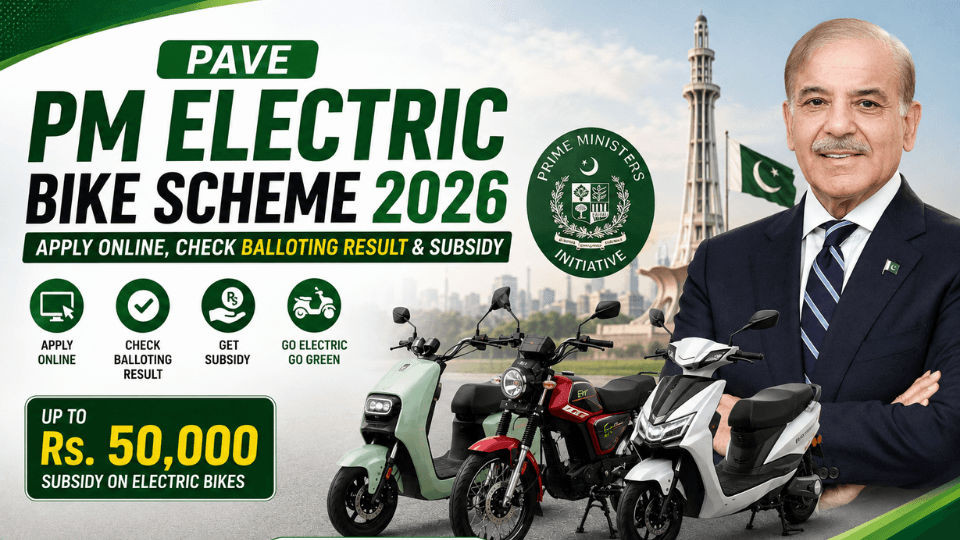
Pakistan's National Electric Vehicle Policy operates under a 2025–2030 framework managed by the Engineering Development Board (EDB) and Ministry of Industries and Production. The target is 30% EV penetration by 2030. Two separate subsidy systems are currently active for electric bike buyers — federal PAVE and Punjab Green Credit — with different amounts, processes, and deadlines.
All figures verified from pave.gov.pk, greenfinance.punjab.gov.pk, EDB announcements, and bank EV desks as of February 2026.
Federal vs Punjab Scheme — Side by Side
| Federal PAVE | Punjab Green Credit | |
|---|---|---|
| Subsidy amount (cash) | PKR 80,000 | Up to PKR 100,000 |
| Subsidy amount (financed) | PKR 50,000 | N/A |
| How it works | Discount at purchase | Buy first, claim reimbursement |
| Portal | pave.gov.pk | greenfinance.punjab.gov.pk |
| Purchase window | Phase 2 opening February 2026 | December 1, 2024 onwards |
| Processing time | Immediate at dealer (post-balloting) | 3–4 weeks after application |
| Who qualifies | Any Pakistani CNIC holder | Punjab residents with registered e-bike |
Which saves more: Punjab Green Credit offers PKR 20,000 more than PAVE on a cash purchase. However it requires paying full price upfront and waiting 3–4 weeks for reimbursement. PAVE applies the discount at point of sale — no floating of cash required.
Example — Yadea C1S at PKR 165,000:
- PAVE cash route: PKR 165,000 − PKR 80,000 = PKR 85,000 out of pocket
- Punjab Green Credit: Pay PKR 165,000 upfront, receive PKR 100,000 back = PKR 65,000 net cost
Choose PAVE if you cannot float the full purchase amount or need the bike immediately. Choose Punjab Green Credit if you have the cash upfront and want the maximum subsidy.
Some dealers allow sequential use — purchasing with PAVE subsidy first, then applying for Punjab Green Credit as a top-up. Confirm with your specific dealer before assuming this is available.
PAVE Phase 2 Details
Phase 1 results: 269,161 applications submitted, 41,000 selected — approximately 1 in 6.5 odds. PKR 80,000 per bike transferred directly to winners' bank accounts via State Bank of Pakistan.
Phase 2 allocation:
- 78,000 electric bikes (nationwide including AJK and Gilgit-Baltistan)
- Proportional quotas for rickshaws and loaders
Subsidy amounts:
- Cash purchase: PKR 80,000
- Bank lease (0% markup, 12–24 months): PKR 50,000 with 10–20% down payment
Financing partners: HBL, Meezan Bank, UBL. Bank lease requires credit check — approval typically takes 3 days but can extend to 2 weeks if documentation has issues.
Phase 2 quota breakdown:
| Quota | Allocation | Phase 2 Slots |
|---|---|---|
| Women | 25% | ~19,500 |
| Commercial use | 10% | ~7,800 |
| Students | 20% | ~15,600 |
| General merit | 45% | ~35,100 |
Commercial slots in Phase 1 were under-subscribed — only 2,847 of 4,000 available slots were filled. Commercial applicants (delivery riders, registered businesses) face less competition.
Application tips:
- Apply within first 48 hours of portal opening — early applicants enter the first ballot
- Portal experiences heavy traffic 6–9 PM daily — apply before midday
- OTP delivery is faster on Jazz than Ufone
- Helpline 1048 hold times average 15–20 minutes — have application ID ready before calling
- Avoid scam calls — official verification calls will have your partial details already; never provide full CNIC to unknown callers
Also see: Pakistan EV & PAVE Scheme 2026 – Full Application Guide
Punjab Green Credit Programme
Active at greenfinance.punjab.gov.pk. Covers purchases from December 1, 2024 onwards. No balloting — all eligible applicants receive reimbursement.
Process:
- Purchase from any EDB-approved dealer. Ensure invoice states "Electric Bike" not "motorcycle."
- Register bike at local excise office (allow 4 hours — multiple counters required).
- Apply online with purchase invoice, registration certificate, CNIC, and bank IBAN.
- Receive reimbursement transfer within 3–4 weeks.
Verified processing times: 18 days (fastest reported), 31 days (slowest reported) as of February 2026.
Sindh Pink EV Scooty Scheme
Sindh is running a separate program offering completely free electric scooters for working women — full purchase price covered plus free helmet, registration, and license fees.
Eligibility: Sindh resident, employed (government or private sector), earning under PKR 50,000 monthly. Backlog is currently 6-plus months.
Punjab does not have an equivalent free scooter program. Punjab women access the standard 25% PAVE quota and Green Credit reimbursement.
Approved Brands
65-plus EDB-registered manufacturers qualify for both PAVE and Green Credit subsidies. Major approved brands include Yadea, Crown Benling, Chang Jiang, Metro EV, Vlektra, ELFA, Jolta, United, and Evee.
Verify the current approved model list at pave.gov.pk before purchasing — not all models from approved brands qualify, and the list is updated periodically.
Tax Incentives (All EV Buyers — No Subsidy Required)
These apply regardless of PAVE or Green Credit participation:
| Tax | Petrol Vehicle | Electric Vehicle |
|---|---|---|
| Sales tax | 17% | 1% |
| Registration fee | PKR 3,000–5,000 | Waived |
| Annual token tax | PKR 1,500–3,000 | Waived |
| Federal Excise Duty | 2.5–7.5% | 0% |
Real Cost of Ownership — 5-Year Comparison
Based on 30 km daily commute (900 km monthly), petrol at PKR 261.50 per liter, KElectric off-peak rate approximately PKR 38–65 per kWh.
| Cost Item | Honda CD70 (Petrol) | Yadea C1S (Electric via Punjab Green Credit) |
|---|---|---|
| Purchase price | PKR 154,900 | PKR 165,000 − PKR 100,000 = PKR 65,000 |
| Monthly fuel / electricity | PKR 6,285 | PKR 879 |
| Oil changes (yearly) | PKR 4,800 | PKR 0 |
| Annual maintenance | PKR 3,500 | PKR 1,200 |
| Battery replacement (year 4) | — | PKR 35,000–45,000 |
| 5-year total | PKR 548,000 | PKR 118,000 |
Monthly saving: approximately PKR 5,400. Annual saving: PKR 64,800. Even accounting for one battery replacement, five-year saving exceeds PKR 400,000.
For delivery riders (100 km daily): Monthly fuel saving: PKR 7,510. Annual: PKR 90,120. Break-even on bike cost in approximately 14 months. Battery replacement needed in year 2 at PKR 35,000–45,000 still leaves significant net positive.
Charging Infrastructure — Current Reality
Public charging stations nationwide: Approximately 20 operational as of February 2026.
| City | Planned | Operational (Verified) |
|---|---|---|
| Islamabad | 52+ | ~8 |
| Karachi | 45 | ~6 |
| Lahore | 38 | ~4 |
Confirmed working locations:
- Islamabad: F-7 Markaz, Blue Area (Service Road South), G-11
- Karachi: Clifton Block 4, DHA Phase 6 (Khayaban-e-Ittehad)
- Lahore: DHA Phase 5, Gulberg Main Boulevard
Public charging tariff (NEPRA-set): PKR 65.25 per kWh. A full charge costs PKR 130–195 and delivers 70–80 km. Home charging at PKR 38–65 per kWh is significantly cheaper.
Home charging requirements:
- Standard 220V outlet is sufficient for most chargers
- Older buildings with 5-amp shared circuits may need a dedicated 15-amp line (cost: PKR 8,000–12,000 including wiring)
- Voltage stabilizer recommended in areas with fluctuation — basic units cost PKR 3,500 and protect against charger damage
- Regular 4-plus hour load-shedding requires alternative charging arrangements: workplace, family home, or business premises
Government target of 3,000 charging stations by 2030 represents 5 years and current installation rate suggests significant gap. Buy based on current home charging capability, not future infrastructure promises.
Battery Performance in Pakistani Conditions
Lithium-ion batteries degrade faster above 35°C. Lahore and Karachi regularly exceed 45°C in summer.
To minimize heat degradation:
- Charge in shade or indoors — not in direct sun
- Wait 30 minutes after riding in heat before charging
- Keep daily charge between 20–80%; charge to 100% only before long trips
- Do not ride if battery casing is hot to touch
Manufacturers claim 800–1,000 charge cycles. Realistic in Pakistani heat with daily commuting: 600–700 cycles — approximately 2.5–3 years for daily commuters before significant degradation.
Battery replacement cost: PKR 35,000–45,000 from authorized dealers. Local assembled alternatives available for PKR 25,000 but carry no warranty and variable cell quality.
Look for "performance warranty" (guarantees 80% capacity after 2 years) rather than "manufacturing defects only" warranty when comparing brands.
Should You Buy Now or Wait?
Buy now if:
- You have reliable home electricity
- Daily round trip is under 60 km
- You qualify for PAVE or Punjab Green Credit
- You are a delivery rider — break-even is under 14 months
Wait if:
- Your area has 12-plus hour daily load-shedding
- You need 100-plus km daily range
- You cannot afford upfront cost even with subsidy
On waiting for better technology: Solid-state batteries are 3–5 years from mass adoption globally. Pakistan typically receives proven technology 2–3 years after international markets. Current lithium-ion is established, parts are available locally, and dealers know how to repair it. The PKR 80,000–100,000 subsidy window is open now. Each PAVE phase becomes more competitive as awareness grows.
Frequently Asked Questions
Can I combine PAVE and Punjab Green Credit?
Some dealers allow sequential use — PAVE discount at purchase followed by Punjab Green Credit top-up application. This depends on specific dealer agreements and current policy interpretation. Confirm before assuming it is available.
Is the Punjab Green Credit scheme still active?
Yes, as of February 2026. It covers purchases from December 1, 2024 onwards. Apply at greenfinance.punjab.gov.pk.
How long does Punjab Green Credit reimbursement take?
Verified range: 18–31 days from application submission depending on processing batch.
What is the PAVE Phase 2 commercial quota?
Approximately 7,800 slots (10% of 78,000). Phase 1 commercial slots were under-subscribed. Delivery riders and registered businesses should apply under commercial category for better odds.
Are women guaranteed a PAVE slot under the 25% quota?
No. The 25% allocation means separate balloting against a smaller pool — not guaranteed selection. Phase 2 has approximately 19,500 women's slots across the country.
What happens after PAVE Phase 2?
Phase 3 is projected for mid-2026 with additional slots. Each phase becomes more competitive. Punjab Green Credit has no announced end date but programs of this type typically close once penetration targets are approached.

Mian Haseeb Subhani
News & Policy Writer
Mian Haseeb Subhani is a news and policy writer based in Lahore who covers Pakistan's electric vehicle policy landscape. He tracks government initiatives including the PAVE scheme, Punjab CM E-Bike Scheme, and federal EV policy developments, translating complex regulatory updates into clear, actionable information for Pakistani riders and buyers. At Electric Bikes Pakistan, he ensures readers stay informed on subsidy deadlines, scheme eligibility changes, and market developments.
View all articles by Mian Haseeb Subhani →