
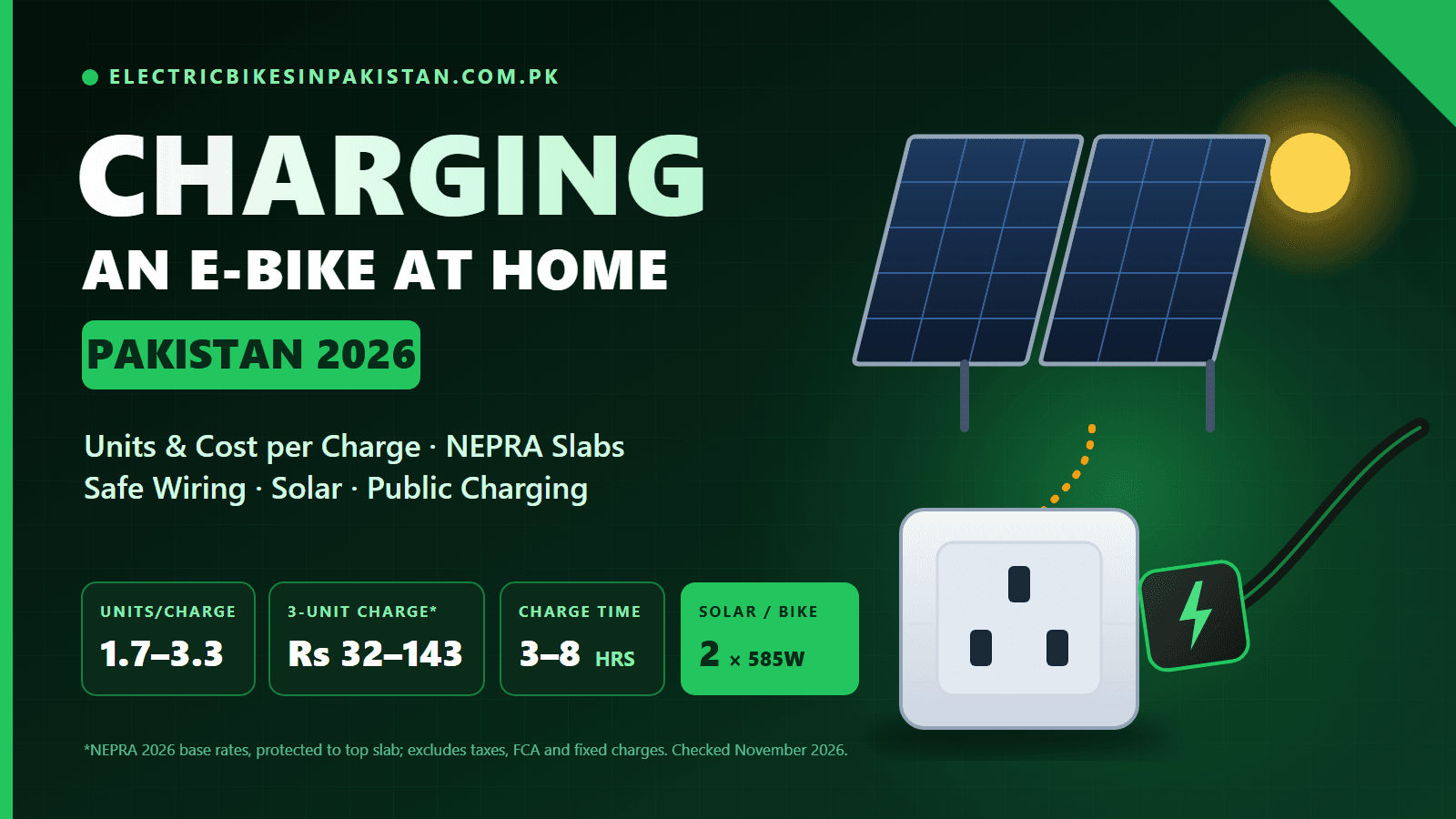
A typical 72V electric bike uses about 2.4–3.3 units (kWh) of electricity for a full charge, and a 60V bike about 1.7 units. At the 2026 NEPRA base rates, the electric bike charging cost in Pakistan for a 3-unit charge works out to roughly PKR 32 on a protected connection and PKR 67–143 on a non-protected one, before taxes and other charges.
This guide covers the charge itself: how to work out units for your battery, what each charge costs at every tariff slab, how long it takes, how to wire a safe charging point at home, whether solar makes sense, and where public charging and battery swapping actually exist today. If you want the monthly petrol-vs-electric saving, read How Much Money Can You Save Switching to an Electric Bike — we do not repeat those tables here.
Tariffs and brand figures verified November 2026. Prices verified November 2026. Confirm current pricing before purchasing.
Electric Bike Charging Cost in Pakistan at a Glance
| Question | Short answer | Source |
|---|---|---|
| Units per full charge (72V bike) | ~2.4–3.3 units | Formula below; Vlektra states ~3 units for Bolt and Velocity 180 |
| Units per full charge (60V bike) | ~1.7 units (60V 26Ah) | Formula below |
| Cost per 3-unit charge, protected | ~PKR 32–39 | NEPRA base rates, 2026 |
| Cost per 3-unit charge, non-protected | ~PKR 67–143 | NEPRA base rates, 2026 |
| Charging time | 3–3.5 h (Vlektra, 10A charger) to 5–8 h (Metro, OKLA) | Brand websites |
| Solar for one bike | 2 × ~585W panels, roughly PKR 50,000 for panels | Retailer listings, Oct 2026 |
| Public charging | 3 Vlektra charging points in Karachi; ezBike battery swapping | vlektra.com, ezbike.pk |
All rupee figures in this post use NEPRA base rates. Your real bill also adds sales tax, other duties, fuel charges adjustment (FCA) and a fixed monthly charge, so the true cost per unit is higher than shown.
How Many Units Does an Electric Bike Use per Charge?
One "unit" on your electricity bill is one kilowatt-hour (kWh). To find how much energy your battery holds, multiply its voltage by its amp-hours (Ah) and divide by 1,000:
Battery energy (kWh) = Volts × Ah ÷ 1,000
The charger also wastes some energy as heat, so the units drawn from the wall are a little higher than what the battery stores. Vlektra's Bolt has a 72V 38Ah battery (2.74 kWh) and Vlektra says it uses about 3 units per full charge — roughly 90% efficiency. We use that same 90% figure below: wall units = battery kWh ÷ 0.9.
Units per full charge by battery size
| Battery | Example bike | Battery energy (kWh) | Units from wall (approx.) |
|---|---|---|---|
| 60V 26Ah | Metro Thrill | 1.56 | ~1.7 |
| 72V 20Ah | OKLA ORBIT (graphene) | 1.44 | ~1.6 |
| 72V 30Ah | OKLA OKT (LFP) | 2.16 | ~2.4 |
| 72V 36Ah | Vlektra Velocity 180 | 2.59 | ~2.9 (Vlektra states ~3) |
| 72V 38Ah | Vlektra Bolt, Metro M6 Empower (NCF) | 2.74 | ~3.0 (Vlektra states ~3) |
| 73.6V 40Ah | Crown Raftaar (LFP) | 2.94 | ~3.3 |
Battery sizes from the brands' own websites, checked 1 November 2026. Units are for a full charge from near-empty. Most riders plug in at 20–30% left, so a normal top-up uses less.
Some brands quote battery energy instead of wall units. ezBike, for example, lists its Volt as "2.6 units per complete charge" for a 2.6 kWh battery — the real draw from your socket will be a little higher once charger losses are added.
Not sure which battery your bike has? The type matters for charging speed and lifespan too — see Electric Bike Battery Types in Pakistan.
Cost per Charge at Every NEPRA Tariff Slab
The table below multiplies the units from the previous section by each 2026 residential base rate. "Small" is a 60V 26Ah bike (~1.7 units), "mid" a 72V 30Ah (~2.4 units), and "large" a 72V 36–38Ah (~3.0 units).
Verified: 1 November 2026. Base rates effective 1 January 2026, as reported by Express Tribune (March 2026).
| Your monthly usage | Base rate (PKR/unit) | Small bike, 1.7 units | Mid bike, 2.4 units | Large bike, 3.0 units |
|---|---|---|---|---|
| Protected, 1–100 units | 10.54 | ~18 | ~25 | ~32 |
| Protected, 101–200 units | 13.01 | ~22 | ~31 | ~39 |
| Non-protected, 1–100 units | 22.44 | ~38 | ~54 | ~67 |
| Non-protected, 101–200 units | 28.91 | ~49 | ~69 | ~87 |
| Non-protected, 201–300 units | 33.10 | ~56 | ~79 | ~99 |
| Non-protected, 301–400 units | 37.99 | ~65 | ~91 | ~114 |
| Non-protected, 401–500 units | 40.22 | ~68 | ~97 | ~121 |
| Non-protected, 501–600 units | 41.62* | ~71 | ~100 | ~125 |
| Non-protected, 601–700 units | 42.76* | ~73 | ~103 | ~128 |
| Non-protected, above 700 units | 47.69 | ~81 | ~114 | ~143 |
*501–600 and 601–700 rates are the figures NEPRA recommended, as reported in March 2026. We could not confirm the final notified rate for these two slabs. Check your DISCO bill.
Base rates exclude taxes, FCA and fixed charges. Since February 2026 most homes also pay a fixed monthly charge — for example PKR 300 for protected homes using up to 200 units and PKR 550 for non-protected homes using 201–300 units (Profit / Pakistan Today, 12 February 2026). Your real cost per charge will be higher than the table.
Vlektra says a charge "costs only PKR 90". That fits a large 3-unit battery at about PKR 30 per unit — between the non-protected 101–200 and 201–300 slabs. Metro's FAQ quotes "around Rs. 100–150 per full charge". Both are brand estimates; your slab decides the real number.
Cost per km
To get cost per kilometre, divide the cost per charge by the distance you actually ride on one charge. For example, the Vlektra Velocity 180 uses about 3 units and gives roughly 110 km in city traffic (our Vlektra review estimate):
| Slab (base rate) | Cost per charge | Cost per km (~110 km) |
|---|---|---|
| Protected 1–100 (10.54) | ~PKR 32 | ~PKR 0.29 |
| Protected 101–200 (13.01) | ~PKR 39 | ~PKR 0.35 |
| Non-protected 101–200 (28.91) | ~PKR 87 | ~PKR 0.79 |
| Non-protected 201–300 (33.10) | ~PKR 99 | ~PKR 0.90 |
| Non-protected 301–400 (37.99) | ~PKR 114 | ~PKR 1.04 |
| Above 700 (47.69) | ~PKR 143 | ~PKR 1.30 |
A bike with a smaller battery and shorter real range lands in a similar per-km band, because it uses fewer units but also goes fewer kilometres. For what this means per month against a petrol 70cc, see the savings calculator post.
Will Charging a Bike Push My Bill into a Higher Slab?
This is the part most "per charge" figures leave out. Charging adds units to the same meter as your fans, fridge and AC, so the bike is charged at whatever slab the whole house lands in.
Example: a home using 170 units a month charges a 3-unit bike 25 times. That adds about 75 units, taking the meter to roughly 245 units. The house is no longer in the 101–200 band; the 2026 base rate for 201–300 non-protected units is PKR 33.10, against PKR 13.01 for protected 101–200 units.
The protected-status risk. Protected consumers pay much lower rates (PKR 10.54 and 13.01) than non-protected ones. News reports and DISCO bill guides say a home stays protected only while it uses 200 units or less each month over the previous six months, and that one month above 200 can remove protected rates for the next six months. We could not read this rule in an official NEPRA or DISCO document, so treat it as a risk to check rather than a confirmed rule:
- Look at the "protected" / "non-protected" line and the last 12 months' units on your current bill.
- If your home is close to 200 units in any month, an e-bike can tip it over — especially in summer.
- Ask your DISCO (LESCO, MEPCO, IESCO, K-Electric etc.) how protected status is decided before you plan your charging around it.
If you are near the line, charging fewer times a month (top up only when below 30%) or using a public charging point for some charges keeps units down.
How Long Does an Electric Bike Take to Charge?
Charging time depends on battery size and charger current (amps). A rough rule: hours ≈ battery Ah ÷ charger amps, plus a little extra at the end while the charger slowly tops up the last few percent.
Brand-stated charging times
| Bike | Battery | Charger | Brand-stated time |
|---|---|---|---|
| Vlektra Velocity 180 | 72V 36Ah LFP | 10A, 220V | 3 h (spec table), 3.5 h (FAQ) |
| Vlektra Bolt | 72V 38Ah LFP | 84V / 10A | 3.5 h |
| Metro (all models) | — | Metro-approved | 5–6 h |
| OKLA ORBIT | 72V 20Ah graphene / 64V 33Ah LFP | — | 6–8 h / 5–6 h |
| ezBike Volt | 2.6 kWh LFP | — | 5 h |
From vlektra.com, metroev.pk/faq, okla.com.pk and ezbike.pk, checked 1 November 2026. "—" means the brand does not publish the figure.
Rough charging time by charger amps
| Battery | 3A charger | 5A charger | 10A charger |
|---|---|---|---|
| 20Ah | ~7 h | ~4 h | ~2 h |
| 30Ah | ~10 h | ~6 h | ~3 h |
| 38Ah | ~13 h | ~8 h | ~4 h |
Our arithmetic from the rule above, from near-empty. Crown's charging guide gives similar ranges: 2–3A chargers take about 4–6 hours and 5–10A chargers about 2–3 hours on its packs.
Should you buy a faster charger? No, unless your brand supplies or approves one. Metro says chargers are "typically rated between 0.2C to 0.5C" of battery capacity (7–18A for a 36Ah pack) and to use only Metro-approved chargers. Vlektra says it does "not recommend using a fast charger" on the Velocity 180. OKLA's warranty does not cover "non-OKLA chargers" or a modified charging profile. A cheap aftermarket fast charger can cost you the battery warranty.
How to Set Up Safe Home Charging
Brand guidance on how to charge is clear. What we could not find from any Pakistani brand or regulator online is specific wiring advice (socket rating, earthing). The checklist below separates the two.
What the brands say
- Use the original or brand-approved charger. Crown: "Always use the original charger that comes with your e-bike." Metro and OKLA say the same and exclude unapproved chargers from warranty.
- Charge in a cool, dry, ventilated place, out of direct sun (Crown's charging guide).
- Let the battery cool for about 30 minutes after a long ride before plugging in (Crown).
- Plug-in order: bike off; connect the charger to the bike first, then to the wall; unplug from the wall first (Crown).
- Never charge a wet bike. Metro: unplug before washing, avoid spraying the charging port and battery, and dry the bike completely before charging.
- Don't leave a battery flat or "improperly charged for long periods" — OKLA lists this as a reason to void the battery warranty. Crown suggests recharging at 20–30% and storing at 50–70%.
Vlektra says its chargers are "smart" and do "not allow overcharging". That protection is built into a branded charger and the bike's battery management system (BMS) — a cheap replacement charger may not have it, which is why we would not leave an unbranded charger running overnight unattended.
Electrician's checklist (general practice)
These points are standard electrical-safety practice rather than brand instructions. Have a qualified electrician check them before you start daily charging:
- A dedicated wall socket in good condition. A Vlektra-type 10A charger delivers about 840W, so it pulls roughly 4A from a 220V socket for several hours. A loose or burnt socket heats up under that kind of steady load.
- Earthing. Make sure the socket's earth pin is actually connected to an earth. Many older Pakistani homes have sockets with no working earth.
- No extension reels or multi-plugs. A coiled reel heats up under a long load, and cheap multi-plugs often have thin wiring.
- A proper breaker on that circuit (MCB, and ideally an RCD/earth-leakage breaker).
- Voltage swings. If your area has severe low-voltage or fluctuation, ask the brand whether a stabiliser is needed — Vlektra says its charger handles fluctuations.
- Charge where a fire would not trap anyone — not on a staircase or next to the only door, and away from fuel or gas cylinders.
For battery care beyond charging (storage, water, monsoon), see our Electric Bike Maintenance Guide.
Can You Charge an Electric Bike on Solar?
Yes, and it suits Pakistan well — but the setup and the 2026 billing rules decide whether it pays.
How many panels for one bike
A 3-unit charge every day needs about 3 kWh of solar output. Studies of Pakistan's solar resource put average output at about 4.1–4.5 units per day for each 1 kW of panels, falling to around 3.9–4 units in winter.
- 2 panels of about 585W (≈1.17 kW) → roughly 4.5–5.3 units a day on average, about 4.5 in winter.
- That covers one large 72V bike charged daily, with some margin for cloudy days and losses.
- A 60V bike (~1.7 units) can manage with one panel in summer, but two give winter headroom.
Rough cost (dated listings)
| Item | Price (PKR) | Source / date |
|---|---|---|
| Jinko Tiger Neo 585/590W panel | ~25,593 each | solarpanelprices.pk, 30 Oct 2026 |
| Longi Hi-Mo X7 585/590W panel | ~25,008 each | solarpanelprices.pk, 30 Oct 2026 |
| Fronus PV 2200 1.6 kW hybrid inverter | ~49,000 | w11stop.com retailer listing (date not shown) |
| Inverex inverters | from ~68,000 | qeemat.com.pk, Oct 2026 |
Two panels cost roughly PKR 50,000. Add an inverter, mounting frame, DC cable, breakers and installation — ask an installer for a quote. These are retailer prices that move with the rupee; confirm with a dealer.
On-grid, hybrid or off-grid?
- On-grid (no battery): cheapest, but solar only works in daylight. To use your own solar for the bike, charge between about 10 am and 3 pm.
- Hybrid (with home battery): lets you charge at night from stored solar, but a battery adds a large extra cost.
- Already have rooftop solar? Then the cheapest move is simply to charge the bike at midday from your existing system.
Net metering is now net billing
NEPRA replaced net metering with net billing under the NEPRA (Prosumer) Regulations 2026, notified on 9 February 2026 (Dawn, 10 February 2026):
- Units you export are no longer swapped one-for-one with units you import. Exports are credited at a much lower rate — reported as about PKR 11 per unit (Dawn) or PKR 8.13 (Profit) — while imports are billed at your normal tariff.
- New agreements run for 5 years (down from 7). The rules apply to systems from 1 kW to 1 MW, and you cannot install beyond your sanctioned load. Your DISCO handles the application for homes under 25 kW.
- Existing net-metering users keep their old terms until their agreement expires, per a NEPRA amendment reported on 3 April 2026. Increasing system size loses that advantage.
- NEPRA issued a further amendment (SRO 1330(I)/2026, 6 August 2026). Check the latest terms with your DISCO or on nepra.org.pk before you apply.
What this means for a bike owner: under net billing, a solar unit you use (by charging the bike at midday) is worth your full tariff, while a unit you export earns only around PKR 8–11. Daytime charging gets the most value from solar.
Public Charging and Battery Swapping in Pakistan
Public options for two-wheelers are still thin. Here is what we could confirm from official sources on 1 November 2026.
Vlektra charging points (Karachi)
vlektra.com lists three charging points, all in Karachi:
| Listed name | Address as given on vlektra.com |
|---|---|
| Shahrah-e-Faisal Charging Point | G-8, Street A/2, Main Shahrah-e-Faisal, City Center, next to Awami Markaz |
| Gulshan-e-Iqbal Charging Point | A-32, Block 10-A, NECHS Flats, Rashid Minhas Road, Gulshan-e-Iqbal |
| "Clifton" Charging Point | Shop 3, City Terrace, Block 11, KDA Scheme 24, Gulshan-e-Iqbal (the website gives this Gulshan address under a Clifton label) |
Vlektra does not publish timings, prices, or whether non-Vlektra bikes can charge there. Call the brand before going.
EV charging station tariff
NEPRA cut the base tariff for EV charging stations to PKR 23.57 per unit plus a market-set margin (Profit / Pakistan Today, 25 May 2025). Stations set their own final price, so a public charge is not automatically cheaper than home charging.
Battery swapping
- ezBike (ezSwap): ezBike runs a battery-swapping network for its own bikes, with an app to find the nearest station. Its Volt model supports swapping in under a minute. ezBike does not publish station cities or numbers on its website.
- Rickshaw swap projects: a Mitigation Action Facility project approved in July 2026 plans 137 swap stations for electric three-wheelers in Faisalabad, Lahore and Multan, and LUMS spin-off Neubolt has a rickshaw swap station with Euro Oil. These are for rickshaws, not motorcycles.
- We could not confirm any other operating swap network for e-bikes. Treat swapping as a bonus, not a reason to buy, until a network covers your area.
Our Charging Tips for Lower Cost and Longer Battery Life
- Know your slab. Check your last 12 bills before buying; the slab decides cost per charge more than the bike does.
- Top up at 20–30%, not from zero, and don't keep the bike at 100% for days.
- Charge at midday if you have solar; under net billing that unit is worth far more used than exported.
- Keep the original charger and replace it only with a brand-approved one.
- Charge in shade in summer. Heat shortens battery life; let the pack cool after a ride.
Frequently Asked Questions
How many units does an electric bike use for a full charge in Pakistan?
A 72V bike uses about 2.4–3.3 units for a full charge, and a 60V 26Ah bike about 1.7 units. Work it out as volts × Ah ÷ 1,000, then divide by 0.9 for charger losses. Vlektra states about 3 units for its 72V Bolt and Velocity 180.
How much does one charge cost?
A full 3-unit charge costs about PKR 32–39 at protected rates and about PKR 67–143 at non-protected rates, using 2026 NEPRA base rates. Taxes, FCA and fixed charges make the real figure higher. A smaller 60V battery costs roughly half as much.
How long does it take to charge an electric bike?
Brand-stated times range from 3–3.5 hours for Vlektra bikes with a 10A charger to 5–8 hours for Metro and OKLA models. As a rough rule, hours ≈ battery Ah ÷ charger amps. Charging from 30% takes less time than from empty.
Can I charge my electric bike from a normal home socket?
Yes. Vlektra, Metro, OKLA and others supply chargers that plug into a standard 220V wall socket. Use a socket in good condition with a working earth, and avoid extension reels and multi-plugs because a charger draws power for hours.
Is it safe to charge an electric bike overnight?
Brands with smart chargers say they stop at full and do not overcharge. Even so, charge in a ventilated spot away from exits, and do not leave an unbranded or damaged charger running unattended overnight. Never charge a wet or hot battery.
Will an electric bike increase my electricity bill?
Yes. Each full charge adds about 1.7–3.3 units to your meter. If that pushes your monthly usage into a higher slab — or above 200 units on a protected connection — the rate on your bill can rise. Check your last 12 bills before deciding.
Can I lose protected status by charging an electric bike?
Possibly. News reports and DISCO bill guides say protected status needs 200 units or less every month for six months, and one month above 200 can remove it for six months. We could not confirm the exact rule in an official document, so ask your DISCO.
How many solar panels do I need to charge an electric bike?
Two panels of about 585W (around 1.17 kW) are enough for one 72V bike charged daily, producing roughly 4.5–5 units a day on average. Charge during daylight unless you also buy a home battery. Two such panels cost about PKR 50,000 (October 2026 listings), plus inverter and installation.
Are there public electric bike charging stations in Pakistan?
Yes, but few. Vlektra lists three charging points in Karachi (Shahrah-e-Faisal, Gulshan-e-Iqbal and one more Gulshan address), and ezBike runs battery-swap stations for its own bikes. We could not confirm public e-bike charging in Lahore or Islamabad.
Can I use a fast charger to save time?
Only if your brand supplies or approves it. Vlektra does not recommend fast chargers for the Velocity 180, and OKLA and Metro exclude unapproved chargers or "improper fast charging" from battery warranty. A wrong charger can cost you the battery.

Saba Rehman
Buying Guide Writer
Saba Rehman is a consumer advocate and buying guide writer based in Islamabad. She specialises in breaking down complex purchasing decisions into practical, actionable advice for Pakistani buyers. At Electric Bikes Pakistan, she covers installment plans, government subsidy eligibility, registration requirements, traffic laws, and city-specific buying recommendations — helping first-time EV buyers navigate the market with confidence.
View all articles by Saba Rehman →

