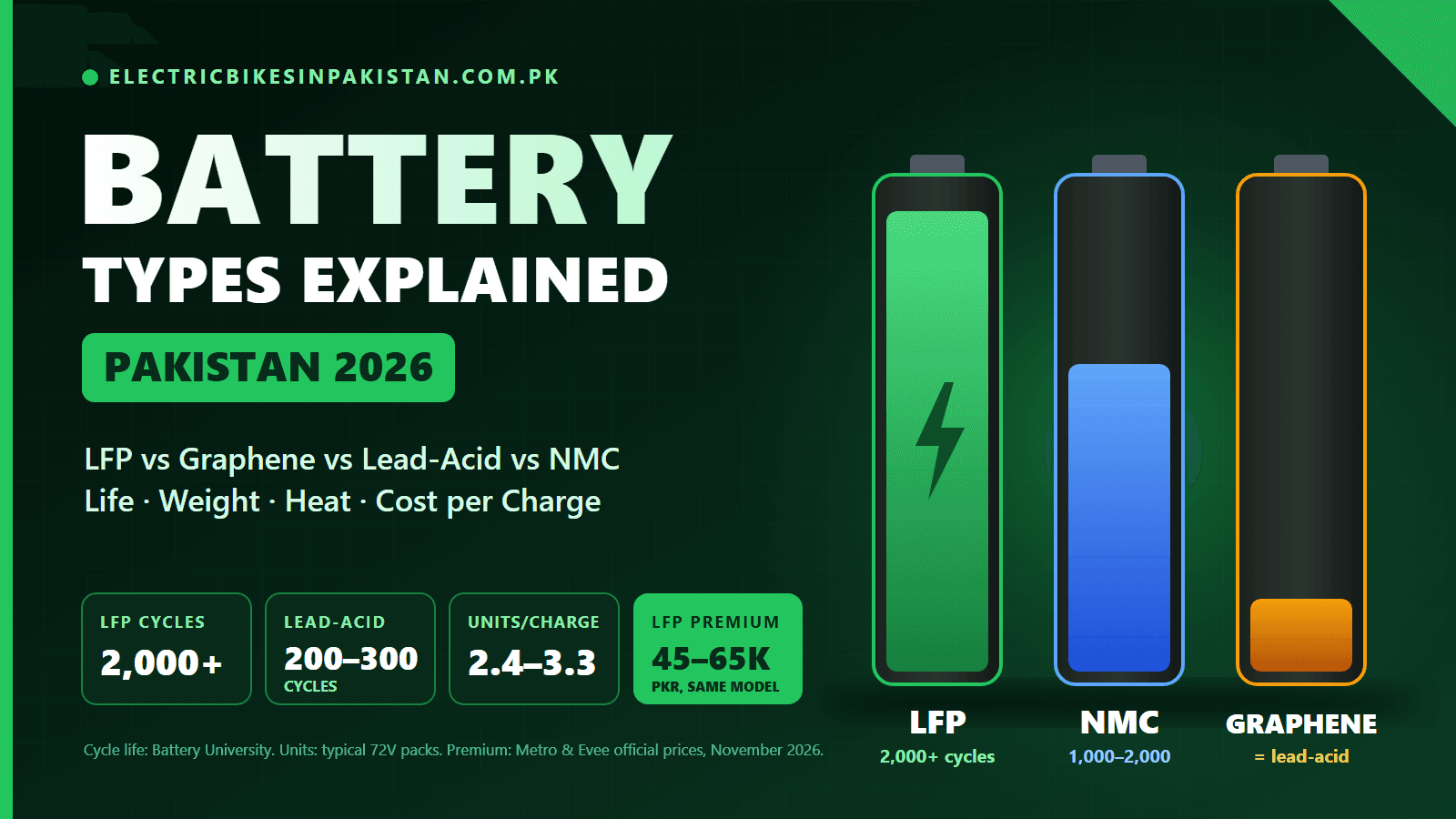
Electric bikes in Pakistan use four battery types: plain lead-acid, "graphene", lithium iron phosphate (LFP) and lithium-ion NMC. The most important thing to know is that a "graphene" battery on a Pakistani scooter is a lead-acid battery with a graphene or carbon additive. It is not a lithium battery, and it ages like lead-acid.
For most buyers, LFP is the best of the four. It lasts several times longer, weighs much less and is the safest lithium chemistry. Graphene bikes cost less to buy. On the same model, the LFP version costs about PKR 45,000–65,000 more on the official sites of Metro and Evee.
This is the site's main battery guide. Every figure comes from a brand spec page, a technical reference or a dated dealer listing, and is linked below. We have not tested these batteries ourselves. Prices verified November 2026. Confirm current pricing before purchasing.
The Four Electric Bike Battery Types in Pakistan at a Glance
| Lead-acid (dry / gel) | "Graphene" (lead-acid + graphene) | LFP (LiFePO4) | Lithium-ion NMC | |
|---|---|---|---|---|
| What it is | Lead plates in acid, sealed | Lead-acid with graphene/carbon in the plates | Lithium iron phosphate cells | Lithium nickel-manganese-cobalt cells |
| Cycle life | 200–300 | ~380 in a lab test; brands claim up to 1,000 | 2,000+ (brands claim 1,100–3,000+) | 1,000–2,000 |
| Life at one full charge a day* | ~1 year | 1–3 years (brand-claim basis) | 5+ years | 3–5 years |
| Battery weight for ~2.3 kWh* | ~58–77 kg | ~58–77 kg | ~19–26 kg of cells | ~10–15 kg of cells |
| Charge time (brand-stated) | 6–8 h | 5–8 h | 4–5 h (60Ah packs 6–7 h) | 3–6 h |
| Heat tolerance | Poor: life halves for every 8°C above 25°C | Same base chemistry as lead-acid | Best of the lithium types; thermal runaway starts ~270°C | Lower threshold, ~210°C |
| Fire risk | Low, but can overheat and dry out above 40°C | Same as lead-acid | Low for lithium | Highest of the four; needs a good BMS |
| Battery warranty in Pakistan | Short; confirm with dealer | 18–24 months | 3–4 years | 3 years (OKLA) |
| Replacement cost (approx.) | PKR 16,000–27,500 (owner reports) | Ask dealer, no listing found | ~PKR 95,000–115,000 for a 60–72V 30Ah pack | Not listed, confirm with brand |
*Our arithmetic. Lifespan = cycle life ÷ 365 charges a year. Weight = 2.3 kWh ÷ typical energy per kilogram for each chemistry. Real packs add a casing and a battery management system (BMS).
Sources: cycle life, energy per kilogram and thermal-runaway temperatures from Battery University BU-205 and BU-201. Heat rule from BU-806a. Graphene lab result from a 2018 ACS Omega study. Warranty and charge times from brand pages listed in the next sections. LFP pack price from a Lahore dealer listing checked 1 November 2026.
Real-world range is typically 60–70% of the brand-stated figure in city traffic, whatever the battery type. A battery's range depends on its size (kWh), not on whether it says "graphene" or "lithium".
What Each Battery Type Actually Is
Lead-acid (dry, gel or "dry cell")
This is the oldest type. A 60V pack is five 12V lead-acid blocks wired together, and a 72V pack is six. It is cheap and does not burn like lithium can, but it is heavy and wears out fast.
Battery University puts deep-cycle lead-acid at 200–300 charge cycles. That falls to 150–200 cycles if you run it flat every time. Heat matters most: each 8°C rise above 25°C cuts a sealed lead-acid battery's life in half. A battery rated for 10 years at 25°C lasts 5 years at 33°C and about 30 months at 41°C. In a Lahore or Multan summer, that is the normal daytime temperature.
"Graphene" — lead-acid with a graphene additive
Graphene is a form of carbon. In the batteries sold on Pakistani scooters, a small amount of graphene or carbon is mixed into the lead plates. The battery is still a lead-acid battery.
The evidence:
- Metro's own pages list a separate chemistry it calls "Nano Carbon Fiber-Graphene", next to two lithium types (LFP and NCM). It gives NCF batteries up to 1,000 cycles and a 24-month warranty, against 36 months for lithium (metroev.pk FAQ).
- The big Chinese makers of "graphene" e-bike batteries, Tianneng and Chaowei (Chilwee), sell them as graphene-enhanced lead-acid batteries. Graphene-Info notes it is hard to verify how much graphene they actually contain (Graphene-Info, Nov 2021).
- A peer-reviewed study added 0.3% graphene to the plates of 48V 20Ah e-bike lead-acid batteries made on a Chilwee production line. Cycle life at full discharge rose by more than 52%, from 250 to 380 cycles (Hu et al., ACS Omega, 2018). So the additive is a real improvement, but on a lead-acid base. It does not reach lithium's 2,000+ cycles.
- In October 2025, the Pakistan Automotive Manufacturers Association (PAMA) said more than 90% of locally sold electric two-wheelers use lead-acid batteries "with a superficial graphene coating". It also said no local maker gives more than 24 months' warranty on them (Profit, 8 Oct 2025). PAMA mostly represents petrol-vehicle assemblers, so treat the 90% figure as its claim, not a survey.
The voltage on the spec sheet is a quick clue. Lead-acid blocks are 12V, so lead-acid and graphene packs come in round numbers: 48V, 60V or 72V. LFP cells are 3.2V, so LFP packs usually read 73.6V (23 cells) or 76.8V (24 cells). NMC cells are 3.6–3.7V, so an NMC pack often reads 74V (20 cells). Cell voltages are from BU-205. This is a clue, not proof, so still ask the dealer for the chemistry in writing.
LFP — lithium iron phosphate (LiFePO4)
LFP is the lithium chemistry used by Vlektra, Crown, Metro's LFP models and OKLA's LFP models. Battery University rates it at 2,000+ cycles and calls it one of the safest lithium-ion types. Thermal runaway, the overheating chain reaction behind battery fires, starts at about 270°C for LFP, compared with about 210°C for NMC.
It stores less energy per kilogram than NMC (90–120 Wh/kg against 150–220 Wh/kg), but about three times more than lead-acid. "Safer" does not mean "cannot catch fire". A damaged or badly built LFP pack can still fail, which is why the BMS and the brand's warranty matter.
Lithium-ion NMC (also written NCM)
NMC is the lithium chemistry used in many laptops, power tools and international EVs. It is the lightest per kWh and gives the most range for its size. Battery University rates it at 1,000–2,000 cycles. In Pakistan, OKLA's "lithium" OKT and OMIGO use 74V 28Ah lithium-ion packs (okla.com.pk), and Metro lists an NCM type (metroev.pk FAQ).
The downside is heat. NMC's runaway threshold is lower, and lithium-ion in general loses capacity faster when it sits hot. Battery University counts anything above 30°C as "elevated temperature". In its table, a cobalt-based lithium battery stored full at 40°C for a year keeps only about 65% of its capacity, compared with 80% at 25°C (BU-808).
Which Brands and Models Use Which Battery
All figures are from each brand's official page, checked 1 November 2026. "Chemistry" is the brand's own wording.
| Brand / Model | Chemistry (brand wording) | Pack | Energy (kWh) | Battery warranty | Price (PKR) |
|---|---|---|---|---|---|
| Metro Thrill | TTFAR Graphene | 60V 26Ah | 1.56 | 18 months | 200,000 |
| Metro M6 Empower NCF | Nano Carbon Fiber | 72V 38Ah | 2.74 | 24 months | 229,000 |
| Metro M6 Empower P-LFP | Portable LFP | 73.6V 30Ah | 2.21 | 36 months | 274,000 |
| Metro M6 Empower Non-P LFP | LFP | 76.8V 30Ah | 2.30 | 36 months | 295,000 |
| Evee Gen-Z (Graphene) | Graphene | 72V 32Ah | 2.30 | 20 months | 177,900 |
| Evee Gen-Z (Lithium) | Phylion Lithium | 76.8V 27Ah | 2.07 | 20 months | 229,900 |
| Evee S1 Air (Graphene) | Graphene | 72V 38Ah | 2.74 | 20 months | 275,000 |
| Evee S1 Air (Lithium) | Phylion Lithium | 76.8V 35Ah | 2.69 | 20 months | 319,900 |
| Crown Roshni | Graphene | 72V 36Ah | 2.59 | — | 215,000 |
| Crown Raftaar | Lithium LFP | 73.6V 40Ah | 2.94 | 4 years / 48,000 km | 309,900 |
| Crown Champion Pro | Lithium LFP | 73.6V 60Ah | 4.42 | — | 345,000 |
| OKLA OKT LFP | LFP | 72V 30Ah | 2.16 | 3 years | 298,000 |
| OKLA OKT | Lithium Ion | 74V 28Ah | 2.07 | 3 years | 369,000 |
| OKLA OMIGO LFP | LFP | 72V 30Ah | 2.16 | 3 years | 299,000 |
| Vlektra Velocity 180 | LFP | 72V 36Ah | 2.59 | 3 years | 339,000 |
| Vlektra Bolt | LFP | 72V 38Ah | 2.74 | 3 years | 549,000 |
Sources: metroev.pk/metro-m6, metroev.pk/metro-thrill, evee.pk Gen-Z, evee.pk S1 Air, Crown model comparison, Crown Raftaar, OKLA OKT, OKLA OMIGO, and vlektra.com product pages (see our Vlektra review). Metro's prices are shown as an offer ending 10 November 2026. "—" means the page does not list it.
Points worth noticing:
- The same bike costs PKR 45,000–65,000 more with LFP. Metro M6 Empower: PKR 229,000 (NCF) against PKR 274,000 (P-LFP). Evee Gen-Z: PKR 177,900 against PKR 229,900. Evee S1 Air: PKR 275,000 against PKR 319,900. Metro Dabang: PKR 190,000 against PKR 255,000.
- Graphene packs often have more Ah but are not "bigger" in value. The Metro M6 NCF has 38Ah against 30Ah on the LFP version, but Metro rates the LFP at more cycles (1,100 against 1,000) and a longer warranty (36 against 24 months).
- Weight shows up in the spec sheet. The graphene Crown Roshni weighs 124 kg. The LFP Crown Raftaar weighs 100 kg, even though its battery stores more energy (2.94 kWh against 2.59 kWh).
- Evee does not say which lithium chemistry it uses. Its packs read 76.8V, the usual voltage for 24 LFP cells, but Evee only writes "Phylion Lithium". Its battery warranty is 20 months for both graphene and lithium versions, which is short for lithium. Ask the dealer before you pay the lithium premium.
- OKLA's OKT page contradicts itself. The spec table lists "Lithium Ion" and "LFP" versions, but the FAQ on the same page calls the OKT battery "graphene". Ask which pack you are getting.
- Jolta: jolta.com.pk did not load when we checked on 1 November 2026, so we have not listed Jolta's battery types. Confirm the chemistry and warranty in writing at the dealer.
Units per Charge and Running Cost
A full charge uses about as many units (kWh) as the battery holds, plus a little lost in the charger.
Battery energy (kWh) = Volts × Amp-hours ÷ 1,000.
Metro gives both sides of the sum. Its 72V 38Ah pack holds 2.74 kWh, and Metro says it uses "3 Units per charge". Its 73.6V 30Ah pack holds 2.21 kWh and uses "2.5 Units" (metroev.pk). That is roughly 10% lost in charging, so below we use units from the wall ≈ kWh ÷ 0.9.
Tariffs are the 2026 NEPRA base rates per unit before taxes and fixed charges, as reported by Express Tribune (March 2026). Protected 101–200 units: Rs13.01. Non-protected 201–300 units: Rs33.10. Top domestic slab: Rs47.69.
| Battery size | Example model | kWh | Units per full charge | Cost at Rs13.01 | Cost at Rs33.10 | Cost at Rs47.69 |
|---|---|---|---|---|---|---|
| 60V 26Ah | Metro Thrill | 1.56 | ~1.7 | ~22 | ~57 | ~81 |
| 72V 30Ah | OKLA OKT LFP | 2.16 | ~2.4 | ~31 | ~79 | ~114 |
| 73.6V 30Ah | Metro M6 P-LFP | 2.21 | 2.5 (Metro) | ~33 | ~83 | ~119 |
| 72V 32Ah | Evee Gen-Z Graphene | 2.30 | ~2.6 | ~34 | ~86 | ~124 |
| 72V 36Ah | Vlektra Velocity 180 | 2.59 | ~2.9 (Vlektra: ~3) | ~38 | ~96 | ~138 |
| 72V 38Ah | Metro M6 NCF | 2.74 | 3 (Metro) | ~39 | ~99 | ~143 |
| 73.6V 40Ah | Crown Raftaar | 2.94 | ~3.3 | ~43 | ~109 | ~157 |
| 73.6V 60Ah | Crown Champion Pro | 4.42 | ~4.9 | ~64 | ~162 | ~234 |
Costs in PKR, rounded.
Worked example. Metro M6 P-LFP, 30 km a day:
- Metro states 100 km at 40 km/h. With our 60–70% city rule, that is 60–70 km real-world per charge.
- 30 km × 30 days = 900 km a month ÷ ~65 km = about 14 full charges.
- 14 × 2.5 units = about 35 units a month.
- At Rs33.10, that is about PKR 1,160 a month, or roughly PKR 1.3 per km.
Check your slab before using these numbers. Thirty-five extra units can push a home over the 200-unit protected limit, which means paying non-protected rates (Rs22.44 and up instead of Rs10.54–13.01). NEPRA has also allowed a fixed monthly charge of up to Rs350 for homes using up to 300 units (Express Tribune). For the petrol comparison at PKR 377.91 per litre (OGRA, 29 Oct 2026), see How to Save Money with an Electric Bike.
Charging and Care in Pakistan's Heat
Heat is the main thing that kills e-bike batteries in Pakistan. Lead-acid and graphene packs lose half their life for every 8°C above 25°C. Lithium packs lose capacity faster above 30°C, and fastest when they sit fully charged in the heat (BU-806a, BU-808).
Screenshot this list:
- Park in shade. A battery under a seat in direct June sun gets far hotter than the air. Shade does more for battery life than any charging trick.
- Let it cool before charging. After a long ride in summer, wait 30–60 minutes before plugging in.
- Charge in a cool, ventilated place. Not in a closed room, a car porch in afternoon sun, or next to a UPS or generator.
- Use the original charger only. A wrong charger can overcharge the pack and usually voids the warranty.
- Lead-acid and graphene: recharge after every ride and never leave it flat. A lead-acid battery left empty sulphates and loses capacity for good. Shallow use helps: Battery University gives 400–500 cycles at 50% depth of discharge, against 150–200 at 100% (BU-201).
- Lithium (LFP and NMC): don't leave it at 100% for days. If you ride short distances, charge before you need it rather than keeping it topped up all the time. Partial discharge is fine for lithium (BU-808).
- Unplug after it is full if your charger does not cut off on its own. Never charge overnight on a damaged or swollen pack.
- Load-shedding: charging in short bursts does no harm to lithium. Lead-acid prefers a complete charge, so plan longer charging windows for graphene bikes.
- Monsoon: do not ride through standing water deep enough to reach the battery. Water in the battery casing is a common reason warranties are refused. More in our maintenance and monsoon guide.
- Long storage (Eid trip, summer holiday): lithium likes about half charge in a cool place. Lead-acid should be stored full and topped up every few weeks.
Warranty and Replacement Cost
Warranty length is the best clue to how long a brand expects its battery to last.
| Battery type | Warranty on official pages (Nov 2026) |
|---|---|
| Graphene / NCF | Metro Thrill 18 months; Metro NCF 24 months; Evee 20 months |
| LFP | Metro 36 months; OKLA 3 years; Vlektra 3 years; Crown Raftaar 4 years / 48,000 km |
| Lithium-ion (NMC) | OKLA OKT/OMIGO lithium 3 years |
| Lithium (unspecified) | Evee 20 months |
Replacement cost (approximate):
- LFP: a Lahore dealer lists a 72V 30Ah LiFePO4 scooter pack at PKR 100,000–115,000 and a 60V 30Ah pack at about PKR 95,000 (Maaz Electronics, checked 1 Nov 2026; the 72V pack was out of stock). A brand-original pack may cost more, so ask the brand.
- Graphene: we found no current dealer listing with a price. Ask the brand service centre for a written quote before you buy the bike.
- Plain lead-acid: owners report PKR 16,000 at Hall Road to PKR 27,500 at a dealer for a full set (PakWheels owner report, see our Jolta review). Treat this as an owner figure, not a price list.
- NMC: OKLA does not list a replacement price. Confirm at okla.com.pk.
So which is cheaper over five years? A lead-acid or graphene pack at one charge a day needs replacing roughly every 1–3 years. An LFP pack rated 2,000+ cycles should outlast its warranty by years. The LFP premium of PKR 45,000–65,000 on the same model costs less than one LFP replacement pack and pays for itself if it saves two graphene replacements.
Which Battery Should You Buy?
Under PKR 200,000, short rides (under 25 km a day): a graphene or lead-acid bike is the only choice at this price. Buy one with the longest written warranty (18–24 months), charge after every ride and keep it shaded. Budget for a replacement battery within about two years.
PKR 200,000–300,000, daily commute (25–60 km): buy LFP. This is where same-model LFP versions sit: Metro M6 Empower P-LFP (PKR 274,000), Evee Gen-Z Lithium (PKR 229,900), OKLA OKT LFP (PKR 298,000), OMIGO LFP (PKR 299,000). Check PAVE eligibility first at pave.gov.pk. See PM Electric Bike Scheme.
PKR 300,000+, long range or delivery work (60+ km a day): LFP with the biggest pack you can afford, such as the Crown Raftaar (40Ah, 4-year warranty) or Champion Pro (60Ah), or the Vlektra Velocity 180. Delivery riders charging twice a day can wear out a graphene pack in about a year.
Upper-floor flat without parking power: you need a removable pack. Lithium is the only practical option. An LFP pack of roughly 20–25 kg can be carried. A 60 kg lead-acid set cannot. Metro sells a "Portable LFP" M6, and OKLA advertises swappable packs on some models.
Want the lightest, fastest bike: NMC gives the most energy per kilogram. Pay extra attention to heat and warranty terms. OKLA's 3-year lithium warranty is a fair benchmark.
Also see: Electric Bike Prices in Pakistan · First-Time Buyer Checklist
Frequently Asked Questions
Is a graphene battery lithium or lead-acid?
A "graphene" e-bike battery sold in Pakistan is a lead-acid battery with graphene or carbon added to its plates. It is not lithium. Chinese makers such as Tianneng and Chaowei sell these as graphene-enhanced lead-acid, and Metro lists its graphene type separately from its lithium types.
Which battery is best for an electric bike in Pakistan?
LFP (lithium iron phosphate) is the best choice for most riders. It is rated for 2,000+ cycles, weighs about a third of a lead-acid pack and has the highest overheating threshold of the lithium types. Brands back it with 3–4 year warranties against 18–24 months for graphene.
How long does a graphene battery last?
Expect roughly 1–3 years with daily charging, and less in a hot city. Metro rates its graphene packs at up to 1,000 cycles, but lab testing of graphene lead-acid showed about 380 cycles at full discharge. Brand warranties of 18–24 months are the safest guide.
Does graphene handle heat better than lithium?
No. Graphene packs are lead-acid, and lead-acid life halves for every 8°C above 25°C. LFP lithium has a thermal-runaway threshold of about 270°C and keeps far more of its life in Pakistan's summers. Shade and a cool charging spot help every battery type.
How many units does an electric bike use per full charge?
Most 72V electric bikes in Pakistan use about 2.4–3.3 units per full charge, and large 60Ah packs use about 5. Work it out as volts × amp-hours ÷ 1,000, then add about 10% for charger loss. Metro states 2.5 units for its 73.6V 30Ah pack and 3 units for its 72V 38Ah pack.
How much does a full charge cost?
A typical 2.5–3 unit charge costs about PKR 33–39 at the protected Rs13.01 rate and PKR 83–99 at the Rs33.10 rate for 201–300 units. These are NEPRA base rates before taxes and fixed charges. Your actual cost depends on which slab your home is in.
How much is a lithium battery for an electric scooter in Pakistan?
A 72V 30Ah LFP replacement pack costs about PKR 100,000–115,000 at a Lahore dealer, and a 60V 30Ah pack about PKR 95,000 (November 2026). Brand-original packs may cost more. Buying the LFP version of a bike upfront costs PKR 45,000–65,000 extra at Metro and Evee.
Can I replace a graphene or lead-acid battery with lithium?
Sometimes, but only with the brand's approval. A lithium pack needs a matching charger and a controller that accepts its voltage, and the swap usually voids the warranty. Ask the brand service centre whether a lithium upgrade is offered for your model.
Is an LFP battery safe? Can it catch fire?
LFP is the safest common lithium chemistry, but no lithium battery is completely fireproof. Its thermal runaway starts at about 270°C against about 210°C for NMC. Use the original charger, don't charge a damaged or swollen pack, and charge away from where people sleep.
How can I tell which battery a bike really has?
Ask the dealer to write the chemistry on the invoice, and check the pack voltage. Round 48V, 60V or 72V packs usually mean 12V lead-acid blocks. 73.6V or 76.8V usually mean LFP cells, and 74V often means NMC. A 12–24 month battery warranty is another sign of graphene/lead-acid.

Qasim Ali
EV Reviewer & Technical Writer
Qasim Ali is an electric bike enthusiast and technical writer based in Karachi. He has personally tested over 10 electric bike models across Karachi's diverse road conditions, with a focus on real-world battery performance, motor reliability, and after-sales service experience. At Electric Bikes Pakistan, he covers brand reviews, model comparisons, and technical specifications to help riders choose the right bike for Pakistan's urban environment.
View all articles by Qasim Ali →